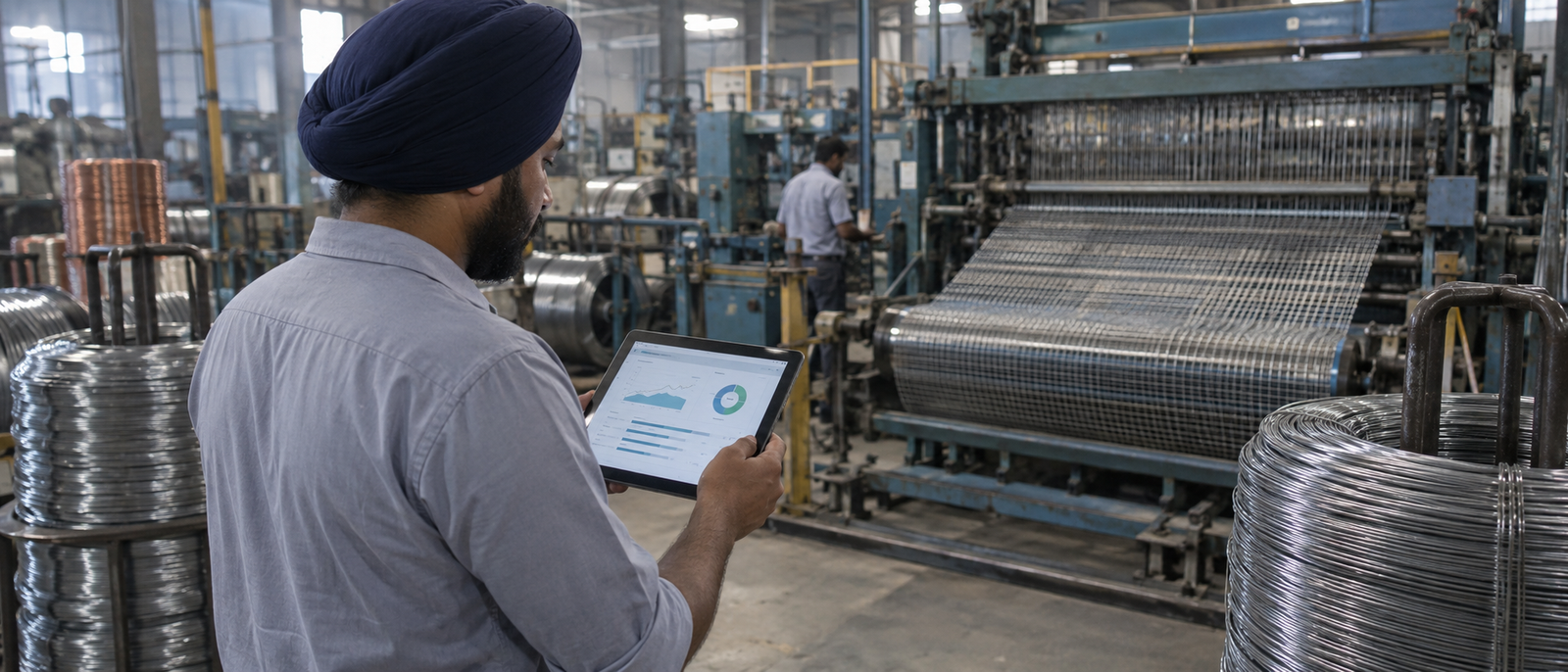
If you run a wire drawing unit or a weaving mill in Punjab, you already know the honest truth: no software vendor in India builds specifically for you. You get offered generic trading ERPs, textile suites built for garment exporters, or steel-industry software built for rolling mills — and you end up bending your process to fit someone else’s workflow. Custom software for wire industry Punjab businesses is a different starting point: build around how drawing, galvanizing, weaving, and dispatch actually happen on your floor, instead of forcing your floor to match a dropdown menu.
Ludhiana and the surrounding belt carry serious industrial weight in both segments. The wire and engineering goods cluster around Ludhiana is home to hundreds of wire drawing and wire plant manufacturers, while the city is separately known as the “Hosiery Capital of India” — home to roughly 10,000 hosiery and knitwear units, around 60 woollen and worsted spinning units, and an estimated 15,000 powerlooms spread across decentralised units. That scale is exactly why generic software struggles here: a wire drawing unit and a weaving mill next door to each other can have almost nothing in common operationally, yet most ERP vendors sell them the same product.
Both industries also share a structural challenge: most software companies build for one or the other, never both. A textile ERP vendor understands GSM and denier but has no idea what a drawing die or a galvanizing line looks like. A metals and engineering ERP vendor understands gauge and wire tensile strength but has never heard of picks per inch. Businesses that touch both worlds — and there are more of them in Punjab than most software vendors realise — end up running two disconnected systems, or none at all. That gap is exactly the opening for custom software for wire industry Punjab businesses that actually span both processes.
Where wire and weaving businesses in Punjab lose time and money
These four problems come up in almost every conversation we have with a wire or weaving business before they invest in custom software for wire industry Punjab operations.
Orders tracked on paper or WhatsApp
Gauge, coating spec, denier, and colour requirements get scribbled across registers and chat threads, and details fall through between the office and the shop floor.
No visibility into machine-wise output
Owners know total production at month-end but not which drawing machine or loom is actually underperforming until it’s too late to fix — exactly the blind spot custom software for wire industry Punjab manufacturers is built to remove.
Raw material wastage goes unmeasured
Wire breakage during drawing and yarn wastage during weaving are treated as “normal loss” because nobody is tracking input-to-output ratios per batch.
Costing built on guesswork
Without batch-level tracking of drawing passes, galvanizing cycles, or loom hours, quoting a fair price for a new order becomes a gut-feel exercise. This is precisely the gap custom software for wire industry Punjab manufacturers close first.
From raw wire rod to dispatch: where custom software fits
The clearest way to see the case for purpose-built software is to walk the production line itself. Here is roughly how material moves through a combined wire and weaving operation, and where a tracking system should be watching:
Every arrow in that chain is a point where a generic accounting or trading tool goes blind. Custom software for wire industry Punjab manufacturers should be built to log data at each of these six steps, not just at the final invoice.
Wire and weaving industry terms worth knowing
A short glossary helps when you’re briefing a software team that hasn’t worked on a shop floor before — these are the terms that should show up in any serious conversation about your requirements. Getting this vocabulary right matters when scoping custom software for wire industry Punjab projects, since imprecise specs are one of the most common causes of delays.
The process of pulling a wire rod through a series of progressively smaller dies to reduce its diameter and increase its length — different from extrusion, which pushes material through a die instead of pulling it.
Coating steel wire with a layer of zinc for corrosion resistance, usually via hot-dip galvanizing or electro-galvanizing. Wire can also be “drawn galvanized” — galvanized before the final drawing pass rather than after.
A textile unit describing yarn thickness, based on the weight in grams of 9,000 metres of yarn. Lower denier means finer yarn; it’s a standard spec field in any weaving or knitting order.
Grams per square metre — the standard way woven and knitted fabric weight is specified and quality-checked, comparable to how gauge is used for wire.
Custom software for wire industry Punjab: what it should include
Once the process is mapped out, the feature list for a proper system becomes obvious. This is what we typically build into a combined wire and weaving management system, and it’s the checklist we use when scoping custom software for wire industry Punjab clients:
Batch-wise raw material tracking from rod/yarn intake through to finished goods, so wastage at each stage is visible.
Machine and loom-wise production logs to spot underperforming equipment before it drags down monthly output.
Spec-driven order management capturing gauge, coating, denier, GSM, and colour against every customer order.
Real batch costing using actual drawing passes, galvanizing cycles, and loom hours instead of flat estimates.
Quality and rejection tracking tied back to the specific batch and shift, not a generic “damage” line item.
Dispatch tied to batch history so any customer complaint can be traced back to exact production conditions.
Off-the-shelf ERP vs custom software built for this industry
The difference becomes obvious once you compare the two side by side — which is exactly why custom software for wire industry Punjab manufacturers keeps coming up as the better long-term investment.
Generic trading ERP
- Built for buy-sell-invoice, not production
- No fields for gauge, denier, GSM, or coating spec
- Wastage and rejects lumped into one “loss” figure
- Machine/loom output not tracked at all
- You adapt your process to the software
Custom-built for wire & weaving
- Modeled on drawing, galvanizing, and weaving stages
- Spec fields matched to how your team already talks
- Batch-level wastage and rejection tracking
- Machine and loom-wise production visibility
- The software adapts to your process
- Purpose-built as custom software for wire industry Punjab manufacturers actually need
This is the same pattern we saw play out with Ludhiana hosiery manufacturers who replaced Excel and WhatsApp with one custom system — the win wasn’t a fancier dashboard, it was software that finally matched how the floor actually worked. The same logic applies to inventory: if you’re still deciding between spreadsheets and a real system, it’s worth reading how inventory management software compares to Excel once order volume grows past a certain point.
Frequently asked questions
Is custom software worth it for a small wire drawing unit?
If you’re running fewer than 3-4 machines with one product line, a well-organised spreadsheet can still work. Once you’re tracking multiple gauges, coating types, or more than a handful of recurring customers, the manual overhead usually costs more than a right-sized custom system. That’s usually the tipping point where custom software for wire industry Punjab businesses starts paying for itself.
Can one system handle both wire drawing and weaving operations?
Yes — since both are batch-based manufacturing processes, a single system can track raw material intake, machine or loom-wise production, and dispatch for both, as long as it’s built with separate spec fields for each product line rather than forcing one generic form. This combined approach is central to how we design custom software for wire industry Punjab manufacturers that run both processes.
How long does it take to build custom software for wire industry Punjab businesses?
A focused first version covering order intake, production logging, and dispatch typically takes a few weeks to a couple of months, depending on how many stages and machines need to be mapped. It’s usually rolled out stage by stage rather than all at once.
Does this replace our existing billing or accounting software?
No — it’s usually built to sit alongside your accounting software and sync invoice-ready data to it, rather than replacing GST billing and compliance tools you already rely on.
What does it cost to build a custom system for a wire or weaving business?
Cost depends on how many production stages, machines, and integrations are involved. It’s best assessed after a short walkthrough of your current process — reach out on WhatsApp or call for a free assessment specific to your setup.
Do you also handle GST billing and compliance for wire and weaving businesses?
We usually integrate with your existing GST billing software rather than rebuilding compliance tools from scratch — production tracking, batch costing, and dispatch data flow into your accounting system so your accountant’s workflow doesn’t change. Keeping compliance and production separate but connected is a deliberate design choice in how we build custom software for wire industry Punjab clients.
Can the system alert us when raw material or finished stock is running low?
Yes — low-stock alerts for wire rod, yarn, dyes, or finished coils and rolls are a standard part of the inventory module, so reordering happens before a machine sits idle waiting on input material. It’s a small feature on paper, but it’s often the single most requested addition once a business goes live on custom software for wire industry Punjab businesses rely on day to day.
Wire drawing units and weaving mills in Punjab have been underserved by software built for other industries for long enough. Custom software for wire industry Punjab manufacturers isn’t about adding more screens to look at — it’s about finally tracking the six or seven decisions a day that actually determine whether a batch is profitable. Whether you run three drawing machines or thirty looms, the underlying idea is the same: the software should learn your process, not the other way around.
Ready to see what custom software could look like for your unit?
Tell us about your drawing, galvanizing, or weaving setup — we’ll map it out together.
Industry scale figures on Ludhiana’s hosiery, spinning, and powerloom clusters, and the wire manufacturing base in the region, are drawn from publicly available industry association and trade directory estimates.