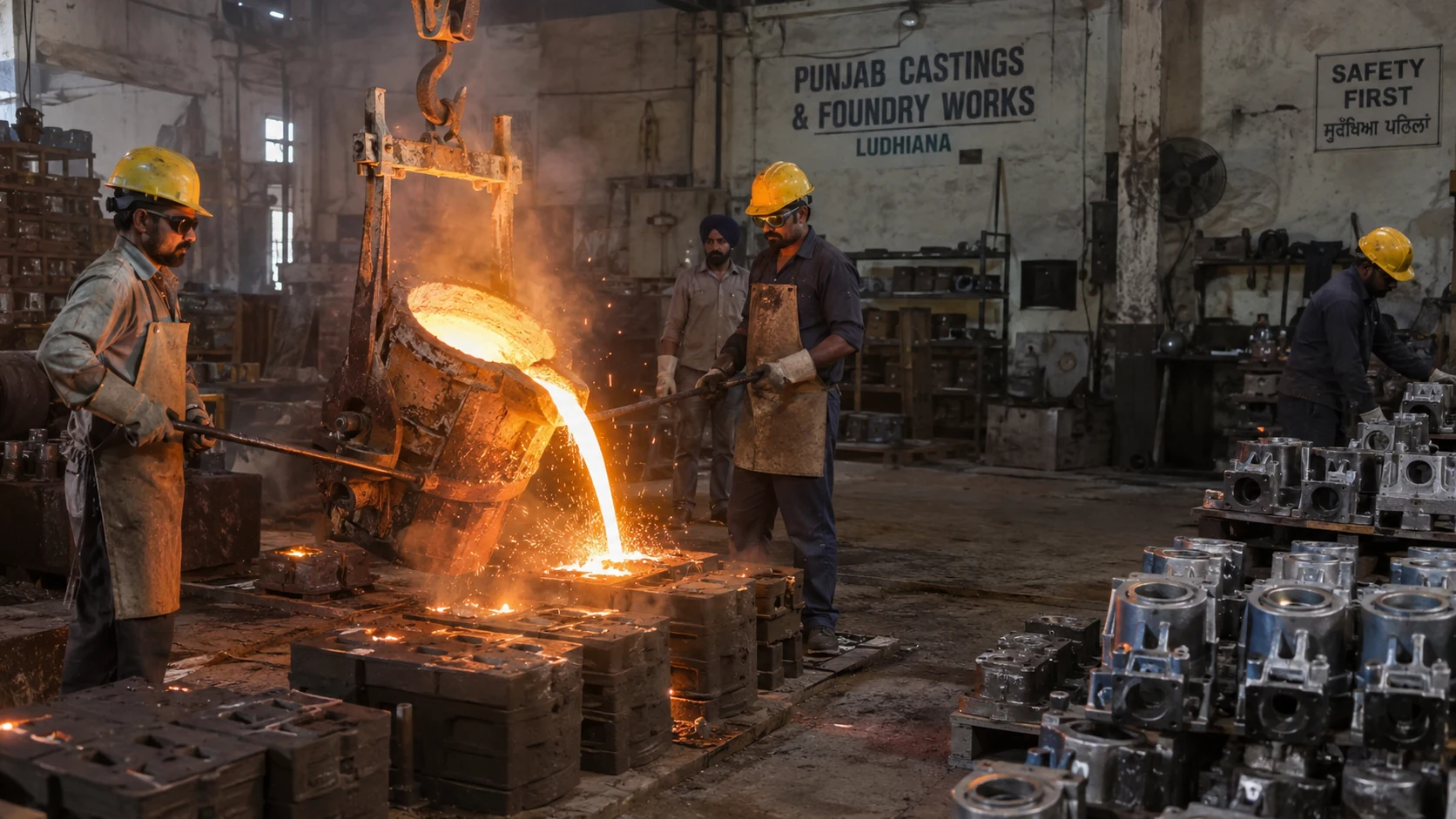
ERP software for casting industry use is not the same problem as ERP for a trading company or a garment unit. A foundry runs on heat numbers, metal yield, mould turnaround and furnace shift logs — none of which show up as a field in a generic ERP template. Ludhiana sits among India’s established casting and foundry clusters, alongside hubs like Jalandhar, Rajkot and Coimbatore, and most of the roughly 5,000 foundries operating across India are small and mid-sized units exactly like the ones here. This is what actually breaks when you force a generic system onto a casting floor, and what a foundry-built one needs to do instead.
Off-the-shelf ERP vs a foundry-built system
Before comparing options, it helps to see exactly where generic ERP software for casting industry deployments tend to fall short on a real shop floor.
Generic ERP
- Tracks finished-goods stock, not metal-in-process
- No field for heat number or batch traceability
- Treats scrap and rejection as a manual write-off
- Inventory units built for pieces, not kilograms of melt
- Needs a consultant to “customise” every workflow change
Foundry-built system
- Tracks metal from furnace charge to dispatch
- Heat number and batch logged automatically
- Scrap, rejection and yield calculated per pour
- Inventory in kg/tonnes alongside piece counts
- Built around how your shop floor already works
What ERP software for casting industry actually tracks
Heat & batch tracking
Every pour logged against a heat number — core to any ERP software for casting industry setup — so any casting can be traced back to its exact melt.
Metal yield & wastage
Input metal vs finished output calculated automatically, pour by pour, shift by shift.
Mould & pattern inventory
Pattern location, condition and reuse count tracked so nothing sits lost in a corner.
Furnace & shift logs
Furnace hours, fuel or power draw, and shift-wise output recorded without a paper register.
Quality & rejection tracking
Rejection reasons captured by batch, so recurring defects show up in the data, not just on the floor.
Dispatch & order tracking
Order status from pattern-ready to dispatched, visible to sales without a phone call to the floor.
Built for Ludhiana’s casting clusters
SG / ductile iron
Non-ferrous casting
Sand casting units
Investment casting
Auto & bicycle parts foundries
The same discipline that makes a payroll or HR system built for how a business actually runs more useful than a generic one applies here — a foundry-built system fits the shop floor instead of asking the shop floor to fit the software.
Frequently asked questions
Why does off-the-shelf ERP software for casting industry use fail most foundries?
Standard ERP is built around finished-goods inventory and invoicing, not molten-metal process tracking. It has no native concept of a heat number, pour yield or furnace log, so foundries end up running these on paper or spreadsheets alongside the ERP instead of inside it.
Is custom software more expensive than buying a foundry ERP module?
Not necessarily. Many “foundry ERP” add-ons from large vendors are licensed as premium modules on top of an existing suite. A custom-built system scoped to exactly what your unit tracks — heat numbers, yield, dispatch — is often cheaper to build and run than licensing a module you’ll only use part of.
Can this integrate with existing accounting software?
Yes. A custom system is built to export or sync with whatever accounting software you already use, so dispatch and purchase data flow through without double entry.
How long does it take to get a foundry system running?
A focused first version covering heat tracking, inventory and dispatch typically takes a few weeks to get live, with quality and reporting modules added once the core is in daily use.
Rolling out ERP software for casting industry units without stopping production
A common worry among Ludhiana foundry owners is downtime: a furnace that stops logging heats for even a shift can throw off costing for the week. A phased rollout of ERP software for casting industry operations avoids this by running the new system alongside existing registers for two to three weeks.
Heat cards and dispatch diaries stay in use while supervisors get comfortable entering the same data digitally. Once shift-wise entries match on both sides, the paper trail is retired module by module, starting with dispatch and inventory before moving to furnace logs and quality checks. This staged approach is why most Ludhiana casting units complete a full switch within six to eight weeks instead of treating it as a single risky cutover.
How long does it take to roll out ERP software for casting industry units in Ludhiana?
Most single-unit foundries go live on core modules — heat tracking, inventory and dispatch — within three to four weeks, with quality and furnace-log modules following once staff are comfortable with daily entries.
Want ERP software for casting industry built around your foundry?
Tell us how your shop floor runs today — we’ll show you what a system built around it looks like.
Choosing the right ERP software for casting industry use ultimately comes down to one question: does it track metal the way your furnace actually produces it, or does it force your process into a generic template?
Sources: industry cluster data on Indian foundries (~5,000 units, largely MSME) and India’s established casting clusters including Ludhiana, Jalandhar, Rajkot and Coimbatore; process detail based on standard foundry operations (heat/batch tracking, pour yield, furnace logging).