

Stock Software for Pharmacies & Medical Stores: Batch, Expiry & Compliance Tracking
Why medicine inventory can’t be run like any other retail stock — and what a proper system actually needs to do.
Walk into most independent pharmacies and medical stores and you’ll find the same quiet problem sitting on the shelf: stock that’s technically “in inventory” but is actually expired, near-expired, or impossible to trace back to a specific batch. Generic retail inventory software counts units. It doesn’t know that unit 47 of Amoxicillin expires in November while unit 48 of the same product, from an earlier batch, expired last month and is still sitting three shelves over. That gap is where write-offs, compliance risk, and — in the worst cases — genuine patient safety issues come from.
Why Pharmacy Stock Management Is Different From Any Other Retail Inventory
A grocery store cares about how many units of an item it has. A pharmacy has to care about which batch each unit belongs to, when that specific batch expires, whether it’s a Schedule H, H1 or X drug requiring a prescription or register entry, and whether it needs cold-chain storage. Two boxes of the same medicine sitting on the same shelf can have completely different expiry dates and completely different compliance requirements depending on their batch. Software that only tracks stock at the product level — the way it would for clothing or hardware — simply can’t answer the questions a drug inspector, or a careful pharmacist, actually needs answered.
What Happens Without Proper Batch & Expiry Tracking
Without batch-level tracking, expiry management becomes a manual, physical task — someone walking the shelves periodically, checking printed dates, and hoping nothing was missed. It’s slow, it’s error-prone, and it scales badly the moment a store carries more than a few hundred SKUs. The financial cost is stock write-offs that could have been avoided with an alert 60 days earlier. The compliance cost is worse: if an inspection finds expired stock still on a sellable shelf, or finds no traceable register for a Schedule H1 sale, that’s a direct regulatory problem, not just a bookkeeping one.
The Batch & Expiry Tracking Dashboard, in Practice
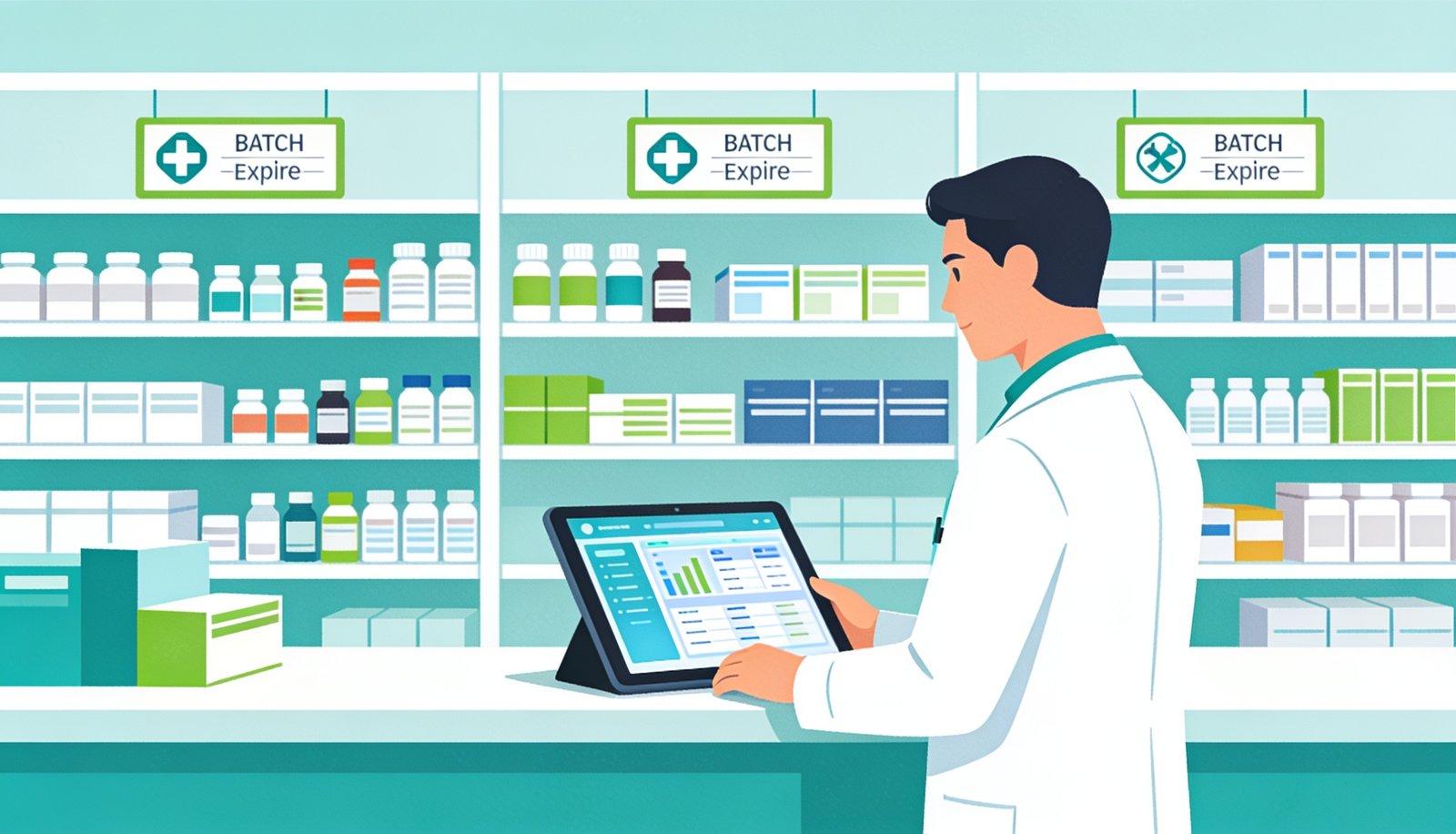
This is what batch-level visibility actually looks like once it’s built into the system — every unit traceable to its batch, with expiry status flagged automatically instead of discovered by accident:
How the Workflow Actually Works, Day to Day
The value isn’t just the dashboard — it’s what happens automatically underneath it, from the moment stock arrives to the moment it’s sold or written off:
Schedule H, H1 & Narcotics Register Compliance
Controlled substances under Schedule H1 require a register recording the prescribing doctor, patient details, and quantity dispensed — traditionally a physical register that’s easy to forget and hard to produce cleanly during an inspection. A properly built system maintains this digitally against every relevant sale, so producing a compliant, exportable register takes minutes instead of a scramble through paper logs.
GST-Compliant Billing for Pharmacies
Medicines carry their own HSN codes and GST slabs, and billing software needs to apply the correct rate automatically rather than relying on someone remembering it per product. Where e-invoicing thresholds apply, that generation needs to happen without a separate manual step — one more place where a generic retail POS falls short of what a pharmacy actually needs.
Multi-Branch & Chain Pharmacy Sync
For pharmacy chains, the same batch of medicine can be sitting unused at one branch while another branch is about to run out — or about to write off a batch it could have transferred instead. Centralised, real-time stock visibility across branches turns that into a simple transfer decision instead of a loss at one location and a stockout at another.
The Real Cost of Getting This Wrong
Expired-stock write-offs, compliance penalties during inspection, and the staff hours spent manually checking shelves all add up quietly over a year — often without anyone tallying the true total until it’s reviewed properly. The businesses that fix this aren’t just avoiding waste; they’re removing an entire category of risk from how the store operates day to day.
How Digital Darzee Builds This
Our stock and inventory systems for retail and manufacturing businesses extend naturally into pharmacy-specific modules — batch and expiry tracking, FEFO logic at billing, Schedule H1 register maintenance, and multi-branch sync, all built around how a real pharmacy counter actually operates rather than a generic retail template.
Frequently Asked Questions
Looking for help with this in practice? Explore our inventory & stock management software for Ludhiana businesses.
Frequently Asked Questions
Why do pharmacies need specialized stock software over generic inventory tools?
Pharmacies require batch and expiry date tracking plus regulatory compliance features that generic inventory software typically doesn’t include out of the box.
Can pharmacy stock software send expiry alerts automatically?
Yes, this is one of the core features — automated alerts before stock expires helps reduce wastage and compliance risk.
Is pharmacy stock software compliant with Indian drug regulations?
Custom-built systems can be configured to match batch tracking and reporting requirements relevant to Indian pharmacy compliance standards.
Tired of writing off expired stock?
Talk to our team about a pharmacy-specific batch and expiry system for your store.