
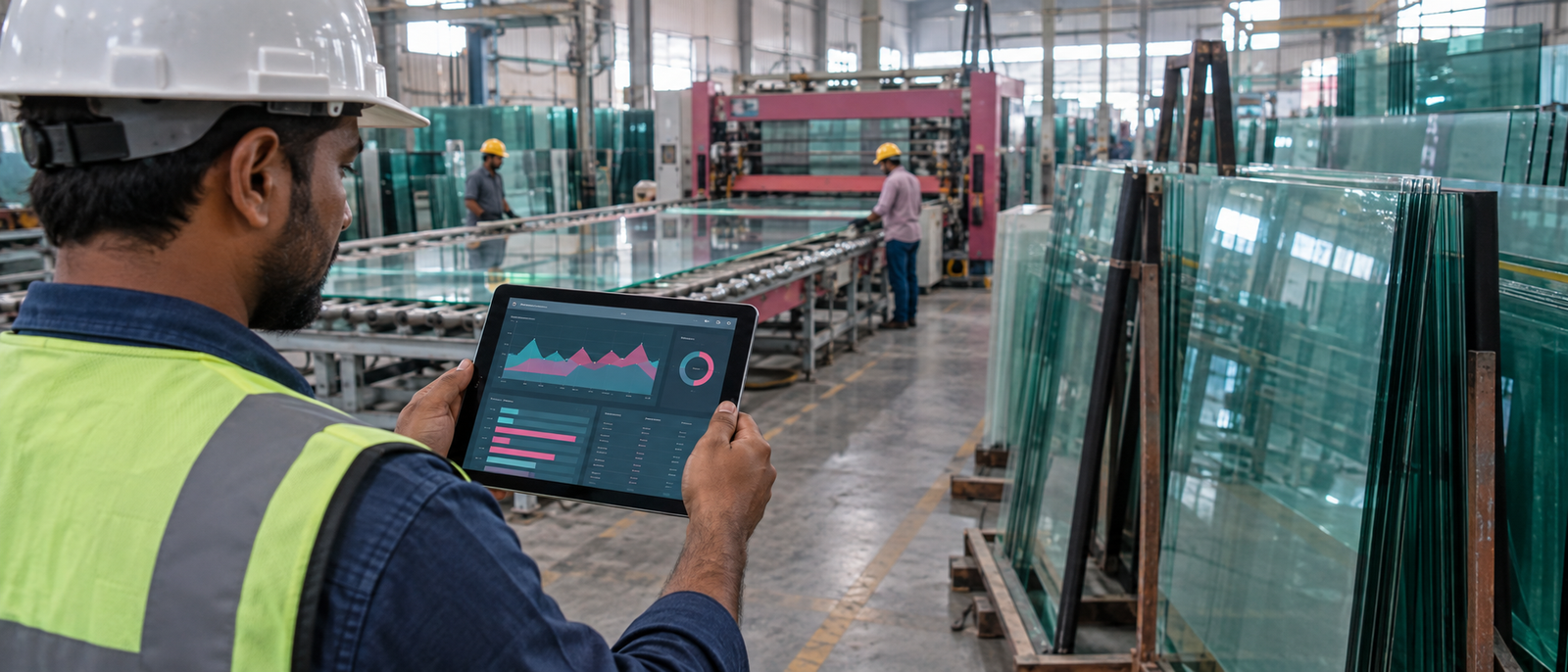
Ludhiana carries real weight in Punjab’s glass processing industry — it accounts for the largest share of glass fabrication units in the state, running toughening furnaces, lamination lines, and DGU (double glazed unit) assembly for the construction and interiors market. Yet most of these units still run on paper job cards and phone calls. Custom software for glass processing Ludhiana businesses is about replacing that paper trail with a system that understands glass the way your team already does — by thickness, type, and order, not generic SKUs.
Established names in the cluster — Dashmesh Glass Industries, Mirage Glasses, and machine suppliers like S. K. Glass Machines — represent an industry that has grown steadily around architectural and safety glass. It’s a made-to-order business: every job carries its own size, thickness, and glass-type combination, which is exactly why generic trading or accounting software struggles to keep up.
The same challenge shows up across other made-to-order fabrication industries in Punjab — a sheet metal unit, a wire drawing plant, or a glass processing unit all face the same core problem: generic software assumes standard products, but the reality on the shop floor is that almost every order is slightly different. That’s why custom software for glass processing Ludhiana fabricators has to start from the process itself, not from a template built for a different industry.
Where glass processing units in Punjab lose time and money
These four problems come up in almost every conversation we have with a glass fabricator before they invest in custom software for glass processing Ludhiana operations.
Specs tracked on paper job cards
Thickness, glass type, edge finish, and size are written on cards that travel the shop floor and easily get misread or lost between cutting and toughening.
No visibility into which stage an order is at
Once a sheet enters the cutting line, the office has no easy way to know if it’s at cutting, toughening, lamination, or ready for dispatch — exactly the blind spot custom software for glass processing Ludhiana units is built to remove.
Breakage and offcut waste goes unmeasured
Glass breaks during processing more often than most industries — without batch-level tracking, nobody can tell if wastage is normal or a real problem.
Quoting built on guesswork
Without a record of actual cutting yield and process time per job, quoting a fair price for a new architectural order becomes a gut-feel exercise. This is precisely the gap custom software for glass processing Ludhiana fabricators close first.
The three glass types your software needs to understand
A generic ERP treats every sheet the same way. Custom software for glass processing Ludhiana fabricators actually needs to understand the physical difference between these three product types, because each has its own process, cost, and lead time:
Toughened / Tempered
Heat-treated single pane, compressed surface for strength — breaks into small granules for safety.
Laminated
Two glass panes bonded with a plastic interlayer — holds together on impact instead of shattering.
DGU (Double Glazed)
Two panes factory-sealed with a spacer and dry air gap between — cuts heat transfer and outside noise.
Glass processing terms worth knowing
Annealed glass reheated near its softening point and rapidly cooled, compressing the surface so it’s several times stronger than regular glass and breaks into small blunt granules instead of shards.
Two or more glass panes bonded with a plastic interlayer. If broken, the interlayer holds the fragments together instead of the glass falling apart — used where holding-together on impact matters most.
Double Glazed Unit (also called an Insulating Glass Unit) — two panes factory-spaced apart and sealed with dry air or gas in the cavity, for thermal and acoustic insulation.
Finishing processes that shape and smooth cut glass edges — beveling angles the edge for a decorative look, edge polishing removes sharpness for safe handling and a clean finish.
Custom software for glass processing Ludhiana units: what it should track
This is the checklist we use when scoping custom software for glass processing Ludhiana clients — the same six data points, whether the job is a single toughened panel or a full DGU facade order.
Spec-driven order intake capturing thickness, glass type, size, edge finish, and quantity against every customer order.
Stage-wise production tracking from cutting through toughening, lamination, or DGU assembly to dispatch.
Sheet inventory and cutting yield tracked so offcut waste is measured, not assumed.
Breakage tracking by stage so recurring damage at toughening or transport is visible and fixable.
Real job costing using actual cutting yield and processing time instead of flat per-sheet estimates.
Dispatch tied to job history so any site complaint can be traced back to the exact sheet, batch, and process stage.
Off-the-shelf ERP vs custom software built for glass fabrication
The difference becomes obvious once you compare the two side by side — which is exactly why custom software for glass processing Ludhiana fabricators keeps coming up as the better long-term investment.
Generic trading ERP
- Built for buy-sell-invoice, not fabrication
- No fields for thickness, glass type, or edge finish
- Breakage and offcuts lumped into one “loss” figure
- No visibility into which process stage a job is at
- You adapt your process to the software
Custom-built for glass processing
- Modeled on cutting, toughening, lamination, and DGU stages
- Spec fields matched to how your team already talks
- Batch-level breakage and offcut tracking
- Stage-wise job status visible to the whole team
- The software adapts to your process
- Purpose-built as custom software for glass processing Ludhiana fabricators actually need
This isn’t theoretical — we’ve already built this for Shiva Glass House in Ludhiana, part of the Shiva Glass Group, where a custom ERP now connects sales, production, dispatch, HR and payroll for their glass fabrication business — with real orders like toughened glass jobs tracked from quote to dispatch in one system.
The same principle that worked for Shiva Glass House applies broadly: once order data and inventory live in one system instead of paper job cards, the same logic used in custom software built for Punjab’s wire and weaving manufacturers — tracking a made-to-order production process stage by stage — turns out to fit glass fabrication just as well.
Frequently asked questions
Is custom software worth it for a small glass processing unit?
If you’re running one cutting line with a handful of regular customers, a well-organised spreadsheet can still work. Once you’re juggling multiple glass types, thicknesses, and toughening batches for different clients, the manual overhead usually costs more than a right-sized custom system. That’s usually the tipping point where custom software for glass processing Ludhiana businesses starts paying for itself.
Can one system handle toughened, laminated, and DGU orders together?
Yes — since all three are stage-based fabrication processes, a single system can track cutting, processing, and dispatch for each, as long as it’s built with separate spec fields per glass type rather than forcing one generic order form. This combined approach is central to how we design custom software for glass processing Ludhiana fabricators that run multiple product lines.
How long does it take to build custom software for glass processing Ludhiana businesses?
A focused first version covering order intake, stage-wise production tracking, and dispatch typically takes a few weeks to a couple of months, depending on how many process stages need to be mapped. It’s usually rolled out stage by stage rather than all at once.
Does this replace our existing billing or accounting software?
No — it’s usually built to sit alongside your accounting software and sync invoice-ready data to it, rather than replacing GST billing and compliance tools you already rely on.
What does it cost to build a custom system for a glass processing unit?
Cost depends on how many process stages, machines, and integrations are involved. It’s best assessed after a short walkthrough of your current process — reach out on WhatsApp or call for a free assessment specific to your setup.
Do you also handle GST billing and compliance for glass fabricators?
We usually integrate with your existing GST billing software rather than rebuilding compliance tools from scratch — production tracking, job costing, and dispatch data flow into your accounting system so your accountant’s workflow doesn’t change.
Can the system alert us when raw glass stock is running low?
Yes — low-stock alerts for specific thicknesses and glass types are a standard part of the inventory module, so reordering happens before a cutting line sits idle waiting on sheet stock.
Glass processing units in Ludhiana have run on paper job cards for long enough. Custom software for glass processing Ludhiana fabricators isn’t about adding more screens to look at — it’s about finally knowing which stage every sheet is at, and what it actually costs to get there. Whether you’re running one toughening furnace or a full DGU assembly line, the underlying idea is the same: the software should learn your process, not the other way around.
Ready to see what custom software could look like for your unit?
Tell us about your cutting, toughening, or DGU setup — we’ll map it out together.
Industry scale figures on Punjab’s glass processing cluster are drawn from publicly available trade directory estimates; the Shiva Glass Group example reflects Digital Darzee’s own client work.