

What Is HTMX? The No-JavaScript-Framework Trend Businesses Should Know About in 2026
A lightweight approach that’s quietly out-starred React and Vue on GitHub — without asking developers to learn a new framework.
Every few years, web development goes through a “the old way was actually fine” moment, and 2026 is shaping up to be one of those years for HTMX. If you haven’t heard the term from your development team yet, you likely will soon — what is HTMX, in plain terms, is a small library that lets developers build interactive websites using mostly HTML, with the server doing the heavy lifting instead of a large JavaScript framework running in the browser.
What Is HTMX, Exactly?
HTMX ships as a single, small JavaScript file added via a standard script tag, and instead of writing components in a framework like React, developers add special HTML attributes that tell the browser to fetch and swap in new content from the server automatically. In practice, that means simple, interactive features — a form that submits without a full page reload, a button that loads more content — can be built with far less code and far less JavaScript than the modern framework approach requires.
Why It’s Suddenly Everywhere in 2026
Two things are driving the renewed interest: bundle size and developer fatigue. HTMX ships at roughly 14KB compared to a typical 42KB baseline for React, which translates directly into faster page loads, especially on slower mobile connections. On top of that, HTMX has reportedly surpassed established frameworks like React, Svelte, and Vue in GitHub stars — a signal that a meaningful number of developers are actively choosing the simpler path rather than defaulting to the biggest name.
Bundle Size Comparison
HTMX ships at roughly a third the size of a typical React setup, cutting the JavaScript a visitor’s browser has to download and run before your site becomes interactive.
The Case Against Constant Framework Churn
Developers who’ve lived through the jQuery-to-Backbone-to-Angular-to-React-to-Vue-to-Next.js cycle know the real cost isn’t learning each new framework — it’s the rewrites, the migrations, and the months of work that come with every “next big thing.” HTMX’s appeal, for a lot of teams, isn’t that it’s flashy; it’s that it lets them build with a backend language they already know well — PHP, Python, or others — and skip an entire layer of front-end complexity that wasn’t always solving a real problem for the site in question.
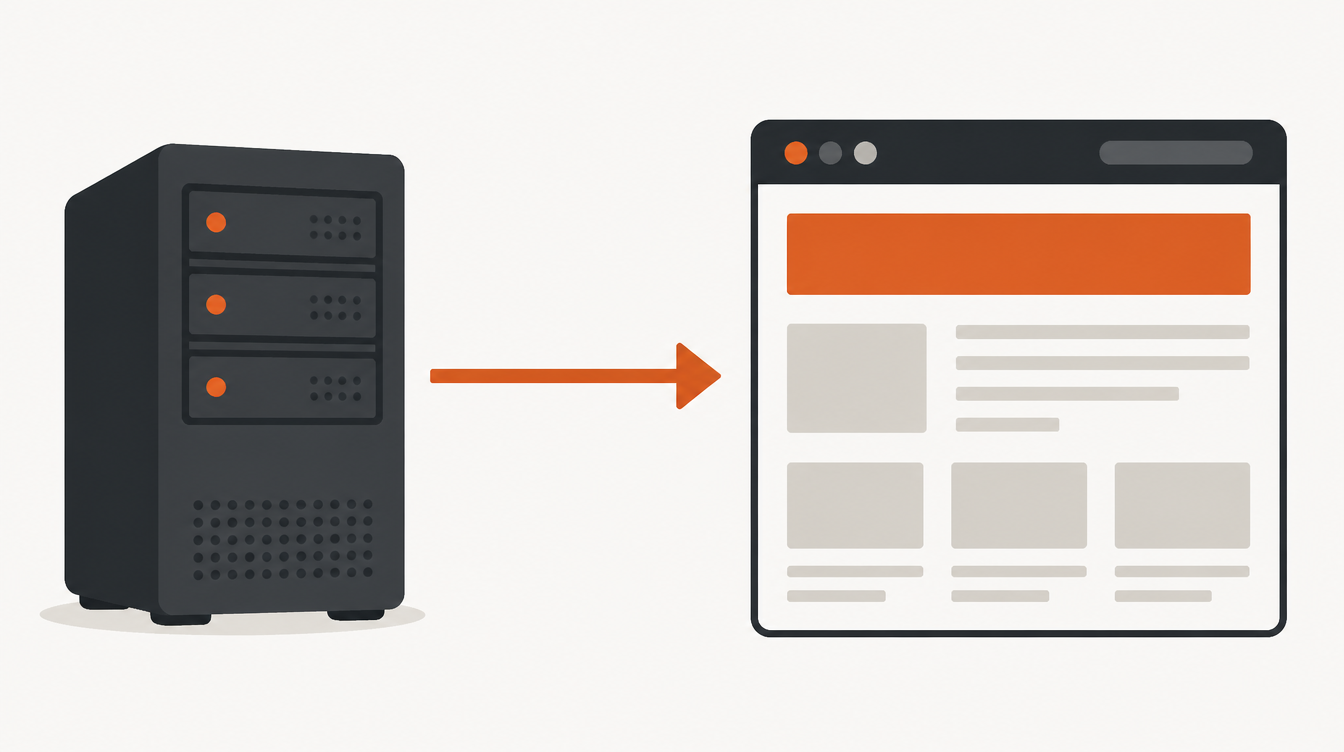
The server sends ready-to-display HTML directly to the browser, instead of the browser assembling the page from a large JavaScript bundle first.
Where HTMX Makes Sense — and Where It Doesn’t
- Content-heavy business websites
- Admin dashboards and CRUD-style tools
- Sites where fast load time matters more than rich animation
- Teams with strong backend skills, lighter front-end needs
- Highly interactive apps (drag-and-drop, real-time collaboration)
- Products needing complex client-side state management
- Teams already deeply invested in an existing React codebase
- Offline-first mobile-style web apps
What This Means for Your Project Budget
Simpler architecture tends to translate into simpler maintenance, which is where a lot of long-term web development cost actually lives. A smaller codebase with fewer moving parts is generally faster for a developer to understand, debug, and extend months or years after the original build — which matters more to a business owner than which framework logo appears in the project README. When we scope a new project, the question we ask isn’t “what’s the trendiest stack” but “what will be cheapest and most reliable to run for the next five years,” and for a growing share of content-heavy business sites, that answer increasingly points toward simpler, server-driven tools like HTMX rather than a full front-end framework.
A Quick Look at Adoption So Far
HTMX isn’t a brand-new experiment — it has been around for several years, but 2026 marks the point where its adoption curve has become hard to ignore. Beyond the GitHub star counts, it’s increasingly showing up in job postings, backend framework documentation, and conference talks alongside mentions of Laravel, Django, and Rails — an indication that it has moved from “interesting side project” to a genuinely mainstream option for teams building server-rendered applications.
Should Your Business Care About This?
Directly, probably not — this is a decision for your development team, not something you need to manage. Indirectly, yes: if your next website or internal tool is content-heavy rather than app-like, asking your developer whether HTMX is a fit could mean a faster, simpler, less expensive build than defaulting to a full JavaScript framework out of habit.
How Digital Darzee Approaches This
We evaluate the right tool per project rather than defaulting to one stack for everything — for content-heavy sites and internal dashboards where speed and simplicity matter most, HTMX paired with a PHP or Laravel backend is increasingly the pragmatic choice, reserving heavier frameworks for projects that genuinely need that complexity.
Frequently Asked Questions
Looking for help with this in practice? Explore our website development services in Ludhiana.
Frequently Asked Questions
Does HTMX replace JavaScript frameworks like React?
Not entirely — HTMX handles many interactive features with much less code, but complex, highly stateful interfaces may still benefit from a full framework.
Is HTMX good for small business websites?
Yes, its small file size (around 14KB vs 42KB for comparable frameworks) and simplicity make it a strong fit for content-focused business sites.
Do I need to learn a new language to use HTMX?
No — HTMX works through HTML attributes, so developers already familiar with HTML and a backend language can pick it up quickly.
Planning a new website or internal tool?
We’ll help you figure out whether HTMX or a full framework is the right fit for your project.
Usually replies within a few hours