

Core Web Vitals 2026: Why 43% of Sites Are Failing the New INP Standard
Google quietly tightened its speed rules this year — and most business websites haven’t caught up yet.
Core Web Vitals 2026 brought two changes that matter a lot more than they first appear: INP became an equal ranking signal alongside page speed and visual stability, and Google lowered the “good” loading-speed threshold from 2.5 seconds down to 2.0 seconds. Confirmed via Google’s Search Central blog on March 18, 2026, these changes have already started showing up in ranking shifts for sites that hadn’t optimized for them.
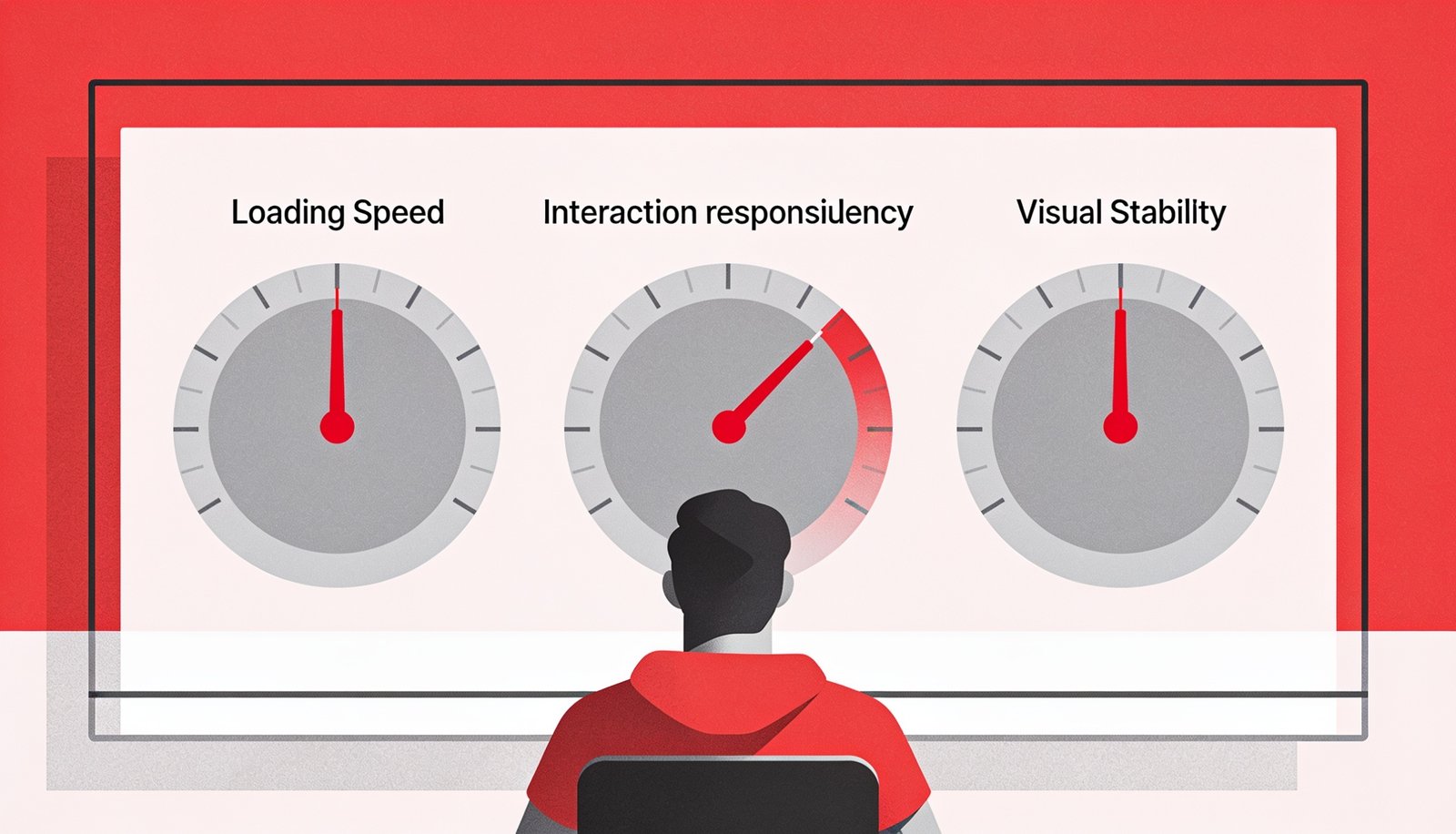
The Three Metrics Behind Core Web Vitals 2026
LCP
Largest Contentful Paint — how fast the main content loads. Tightened from 2.5s.
INP
Interaction to Next Paint — how fast the page responds to a tap or click.
CLS
Cumulative Layout Shift — how much content jumps around while loading.
Why INP Is Failing So Often
Heavy JavaScript execution and third-party scripts are responsible for roughly 90% of INP violations — think chat widgets, ad scripts, analytics tags, and bloated page builders all competing for the browser’s attention the moment a visitor taps something. Lean code and asynchronous script loading aren’t optional refinements anymore; they’re close to mandatory for passing this metric consistently.

The gap between a tap and the page actually responding is exactly what INP measures — and it’s usually caused by scripts running that have nothing to do with what the visitor just clicked.
Real Users Now Matter More Than Lab Tests
Another quiet but significant shift: Chrome UX Report field data — measurements from actual visitors on actual devices — now carries more weight in ranking signals than lab-based test scores. This means a site that looks fast in a controlled testing tool but is genuinely slow for real visitors on average phones and networks will no longer get the benefit of the doubt.
A Practical Fix Checklist
Why This Matters More for Smaller Business Sites
Larger competitors often have dedicated teams tracking this; smaller business sites frequently run on page builders and plugin-heavy setups that are especially prone to INP failures. Following Google’s March 2026 core update, pages ranking in position 1 already show a meaningfully higher Core Web Vitals pass rate than pages ranking around position 9 — a gap that’s likely to widen, not shrink, as this becomes more central to ranking.
What Changed Compared to the Previous Standard
Before this update, INP existed as a supplementary metric that Google tracked but didn’t weight as heavily as loading speed or visual stability — a site could compensate for a mediocre INP score with strong performance elsewhere. That’s no longer the case; all three metrics now carry comparable weight, which means a site can’t coast on fast loading alone if it responds sluggishly to actual user interaction. The tightened LCP threshold compounds this: sites that were comfortably passing at 2.4 seconds now find themselves just outside the “good” band, even though nothing on their site technically changed.
A Realistic Timeline for Fixing This
Most of the checklist above can be implemented over two to four weeks without a full site rebuild: auditing and trimming third-party scripts typically takes the least effort for the biggest INP improvement, while image optimization and layout-shift fixes are usually quick wins that can be handled within the same sprint. Sites built on heavily customized page-builder themes sometimes need more substantial rework, since some builders inject scripts that are difficult to remove without breaking other functionality.
How Digital Darzee Approaches This
We build with lean, minimal third-party scripts by default and test against real-user field data rather than relying solely on lab scores, so client sites are positioned to handle Core Web Vitals 2026 requirements rather than scrambling to fix them after a ranking drop. For the complete technical detail on these thresholds, Google’s own web.dev guide to INP is the most authoritative source. We also touched on the underlying speed-optimization work in our earlier piece on static vs dynamic website architecture, which affects how much script weight a site carries by default.
Frequently Asked Questions
Looking for help with this in practice? Explore our website development services in Ludhiana.
Frequently Asked Questions
What replaced FID in Core Web Vitals?
INP (Interaction to Next Paint) replaced First Input Delay as the responsiveness metric, and it’s stricter — many sites fail its under-200ms target.
Why are 43% of sites failing the new standard?
Most failures come from heavy JavaScript blocking the main thread during user interactions, which INP measures much more precisely than the old FID metric.
Does Core Web Vitals affect Google rankings?
Yes, it’s a confirmed ranking factor, though content relevance still matters more — Core Web Vitals mainly acts as a tiebreaker between similar pages.
Not sure how your site scores on Core Web Vitals 2026?
We’ll run a free field-data audit and show you exactly what’s slowing you down.
Usually replies within a few hours